Our online chat, online enquiry form and course register interest are temporarily offline due to maintenance and will be available again from Monday.
Skip to main content
Start quiz

- Go to homepage
- Course areas
- Music and Production
- Diploma of Music (Performance)
Overview
About this course
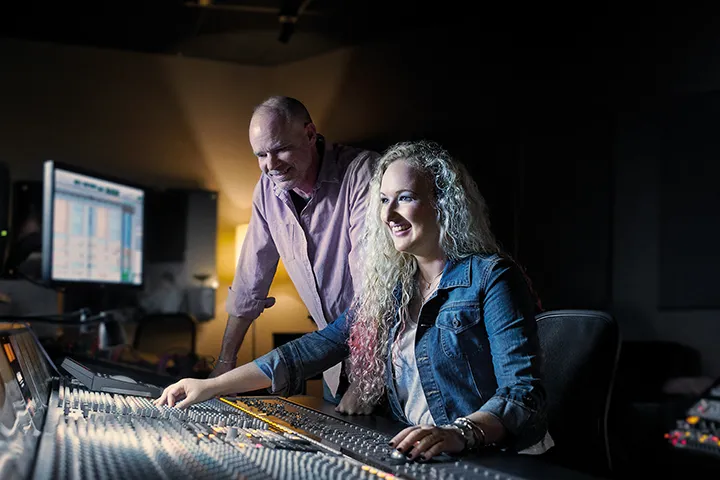
Gain the confidence and experience you need to succeed as a performer, recording artist or session musician. Explore and refine your sound through performance, composition, collaboration in bands and music technology skills.
Outcomes
What you'll gain
Learning outcomes
Through a mixture of theory and practical course work, learn to:
explore instrument or vocal technique
record your song ideas with music production software
perform in a group and as a soloist
apply stagecraft skills
improve critical listening skills
write and arrange music using technology.
Course outcomes
Learn core skills that prepare you for opportunities in your chosen field.
A nationally accredited qualification at a diploma level.
Specialist skills and knowledge to continue your music career and take on freelance opportunities.
Experience creating and recording music in rehearsal or recording studios.
Confidence to perform live.
A network of music industry professionals.
A strong pathway to continue your studies and enhance your career opportunities.
Suitability
Is this course right for you?
Entry requirements
This course requires evidence of previous experience or study before you can enrol.
You must demonstrate one of the following:
Successful completion of the Certificate III in Music (Performance), Certificate IV in Music (Performance) or equivalent. You’ll need to show your certificate or transcript as proof.
Attend a pre-admission interview or audition to assess your music skills and knowledge. We’ll contact you to explain the requirements and arrange a suitable time.
Completion requirements
During your study, you'll need to provide your teacher with the following evidence:
Entry recommendations
To be prepared for this course, we recommend that you have:
experience playing an instrument, performing as a vocalist and/or writing music or songs
an interest in exploring different music styles
basic knowledge of music theory, including key signatures and simple notation
access to your own instrument or microphone
access to a computer with a stable internet connection, Microsoft Office and music production software. If you don’t have your own, you can access these at a TAFE NSW campus
the ability to attend and travel to live performances and events outside class hours, including evenings and some weekends.
The following foundation skills
You take charge of your learning and can finish tasks on time by yourself.
You can read longer text and understand their main ideas.
You can write longer paragraphs and texts that explain your ideas clearly.
You can solve maths problems you often see in real life.
You can join group talks and share your ideas clearly.
You can use digital tools to do everyday tasks like writing or finding information.
We tailor our courses to meet local community needs, so some campuses may have extra entry requirements. Check your preferred location for details. Need help preparing? Contact us for support.
Find Your Fit
This simple tool guides you to a suitable course level based on your foundation skills and confidence.
Pathways
Future career and study options
Career pathways
Our graduates go onto roles like:
Music Professionals
Music Professionals write, arrange, orchestrate, conduct and perform musical compositions.
Full-time share Full-time workers usually work 35 hours or more a week (in all their jobs combined).
35%
Employment size Employment size is the number of workers who do this as their main job.
4,400 workers
Average age This is the average age of all workers in this job.
42 years
Weekly pay Median earnings are shown for full-time, non-managerial employees paid at the adult rate, before tax or any amounts that are salary sacrificed. These figures are a guide to earnings only and should not be used to determine a wage rate.
$1,310
Average full-time The average full-time hours that people in this role work each week.
45 hours
Skill level rating Skill level ratings are based on the range and complexity of job roles. In general, the higher the skill level, the more formal education and training, previous experience or on-the-job training needed to be good at the job.
Very high
Gender share
26% female
Future growth The Department of Employment, Skills, Small and Family Business estimates the likely change in number of workers in this role, or industry, over the next 5 years. Future growth is the likely percentage change compared to all other job roles.
Strong Growth
Other jobs include: recording artist, session musician, session singer, live performer, songwriter, composer and music tutor.
Study pathways
Take your study further with other courses offered at TAFE NSW:
Previous study1 Course
Begin here to gain experience and confidence in this study area.
Further study1 Course
Advance your skills to take your career to the next level
Related study2 Courses
Learn core skills that prepare you for opportunities in your chosen field.
Your experience counts
At TAFE NSW, we recognise your previous study and work experience. You can apply for recognition of prior learning or a credit transfer with any of our courses. If you're successful you'll get your qualification faster.
Units
Units taught in this course
Courses are made up of a combination of both core and specialty units. In the Diploma of Music (Performance) qualification, you’ll need to successfully complete 16 units of competency, including 4 core and 12 speciality units.
Please note, not all specialty units are offered at every TAFE NSW location. It is highly recommended that you check with your preferred campus for information about the specialty units offered at that location.
Core units - 4
Core units are central to the job outcomes of a particular industry or occupation. These are the units industry has agreed are essential to be capable and qualified at a particular study level.
Manage copyright arrangementsCUACMP511
Provide freelance servicesCUAIND412
Enhance professional practice using creative arts industry knowledgeCUAIND512
Develop and implement own self-care plan in the creative industriesCUAMWB401
TAFE NSW services
Facilities and support
TAFE NSW provides support services across all campus locations and online. Whatever your needs or circumstances, we have the people, resources, counselling and facilities to support you in focusing on your studies.
TAFE NSW Disability Support Service
TAFE NSW Language, Literacy and Numeracy (LLN) support
TAFE NSW Aboriginal Support; Learner support (ABE)
TAFE NSW Careers, Counselling and Pathways Service
TAFE NSW Libraries
Scholarship programs - be supported as you explore your talents and fulfil your potential
Read&Write literacy and study support software is available free for all TAFE NSW students to use while studying on campus and at home
LinkedIn Learning - an online resource which offers innovative courses and tutorials to improve your personal and professional skills
Student associations - get social with our student community
Study options