Skip to main content
Start quiz

- Go to homepage
- Course areas
- Aviation and Aircraft Maintenance
- Certificate IV in Aeroskills (Avionics)
Overview
About this course
Start your journey in avionics with this practical course. Become an aircraft mechanical engineer (AME) and learn to test, install and fix electrical systems. You'll help keep people safe while they travel on all types of aircraft.
Outcomes
What you'll gain
Learning outcomes
Through a mixture of theory and practical course work, learn to:
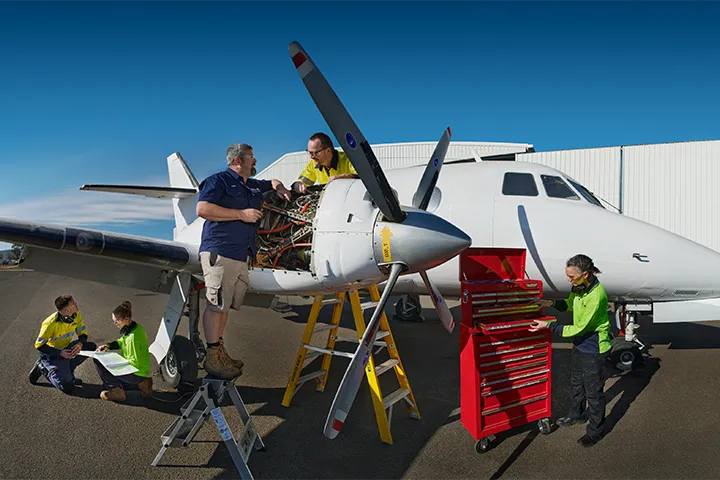
work on a range of real aircraft that are no longer in use
test and fix a variety of aircraft in a workplace setting
train while supervised by a licensed aircraft maintenance engineer (LAME)
perform safe and sustainable avionic maintenance industry practices.
Course outcomes
Learn core skills that prepare you for opportunities in your chosen field.
Fix aircraft in a controlled training area.
Solve and explain avionics problems.
Learn under a licensed aircraft maintenance engineer.
Understand the latest in safe and sustainable avionic maintenance practice.
Build a strong pathway to further study in the Diploma of Aeroskills (Avionics) and train to become a licensed aircraft maintenance engineer.
Suitability
Is this course right for you?
Entry requirements
This course requires evidence of previous experience or study before you can enrol.
Apprenticeship
Be employed as an apprentice in the industry.
Register with an Apprenticeship Connect Australia Provider (ACAP) who will support your application.
Non-apprenticeship
This course may be offered as a non-apprenticeship. Check your preferred campus page for more information.
Non-apprenticeship pathways for trade-related qualifications allow you to have your industry skills assessed through recognition of prior learning (RPL) and undertake gap training to gain a trade qualification.
To take this course as a non-apprenticeship, you must: be at least 21 years old as shown by photo identification, have at least 2 years of work experience in this occupation or trade as shown by employee records such as your resume or letters from your employers, be currently employed in the relevant industry as shown by a letter from your employer.
Completion requirements
During your study you'll need to provide your teacher with the following evidence:
An Aviation Security Identification Card (ASIC)
Entry recommendations
To be prepared for this course, we recommend that you have:
a genuine interest in the aviation industry and aircraft maintenance
strong spatial awareness and hand-eye coordination
the ability to read, write and speak English at a Year 10 level or equivalent.
The following foundation skills:
You can plan your work and try to solve problems on your own.
You can read longer texts and understand their main ideas.
You can write short sentences and paragraphs that others can understand.
You can speak clearly and explain your thoughts in a group.
You can use maths to work out more detailed problems in different settings.
You can use email, search the internet, and open files.
We tailor our courses to meet local community needs, so some campuses may have extra entry requirements. Check your preferred location for details. Need help preparing? Contact us for support.
Find Your Fit
This simple tool guides you to a suitable course level based on your foundation skills and confidence.
Pathways
Future career and study options
Career pathways
Our graduates go onto roles like: aircraft mechanical engineer (AME) specialising in aircraft maintenance and electronics and licensed aircraft mechanical engineer (LAME).
Licensing
An Aviation Security Identification Card (ASIC) is required to work in the avionics industry. You’ll need this to complete work as an apprentice.
Study pathways
Take your study further with other courses offered at TAFE NSW:
Previous study0 Courses
Begin here to gain experience and confidence in this study area.
The Certificate IV in Aeroskills (Avionics) does not have any pre-requisite courses.
Further study1 Course
Advance your skills to take your career to the next level
Related study0 Courses
Learn core skills that prepare you for opportunities in your chosen field.
The Certificate IV in Aeroskills (Avionics) does not have any related courses.
Your experience counts
At TAFE NSW, we recognise your previous study and work experience. You can apply for recognition of prior learning or a credit transfer with any of our courses. If you're successful you'll get your qualification faster.
Units
Units taught in this course
Courses are made up of a combination of both core and specialty units. In the Certificate IV in Aeroskills (Avionics) qualification, you’ll need to successfully complete 25 units of competency , including 12 core and 13 speciality units.
Please note, not all specialty units are offered at every TAFE NSW location. It is highly recommended that you check with your preferred campus for information about the specialty units offered at that location.
Core units - 12
Core units are central to the job outcomes of a particular industry or occupation. These are the units industry has agreed are essential to be capable and qualified at a particular study level.
Conduct self in the aviation maintenance environmentMEA118
Use electrical test equipment in aviation maintenance activitiesMEA296
Perform basic hand skills, standard trade practices and fundamentals in aviation maintenanceMEA158
Apply quality standards during aviation maintenance activitiesMEA156
TAFE NSW services
Facilities and support
TAFE NSW provides support services across all campus locations and online. Whatever your needs or circumstances, we have the people, resources, counselling and facilities to support you in focusing on your studies.
TAFE NSW Disability Support Service
TAFE NSW Language, Literacy and Numeracy (LLN) support
TAFE NSW Aboriginal Support; Learner support (ABE)
TAFE NSW Careers, Counselling and Pathways Service
TAFE NSW Libraries
Scholarship programs - be supported as you explore your talents and fulfil your potential
Read&Write literacy and study support software is available free for all TAFE NSW students to use while studying on campus and at home
LinkedIn Learning - an online resource which offers innovative courses and tutorials to improve your personal and professional skills
Student associations - get social with our student community
Study options