Skip to main content
Start quiz

- Go to homepage
- Course areas
- Healthcare
- Diploma of Nursing
Overview
About this course
Begin a high-energy, rewarding and meaningful career where you can make a lasting impact on people's lives. Become an enrolled nurse and work under the supervision of a registered nurse in acute, aged care, rehabilitation or mental health.
Apply for the Diploma of Nursing
Watch our video to find out more about applying for the Diploma of Nursing.
Outcomes
What you'll gain
Learning outcomes
Through a mixture of theory and practical course work, learn to:
care for patients with many health needs
assess client health and interpret health information
understand basic anatomy and physiology
follow infection control practices
administer and monitor medicines and intravenous therapy
plan, check and review nursing care plans
assess and manage wounds in a clinical setting
communicate with patients and co-workers
follow legal and ethical requirements at work.
Course outcomes
Learn core skills that prepare you for opportunities in your chosen field.
Graduate with a nationally accredited diploma and become eligible to apply for registration as an enrolled nurse through the Australian Health Practitioner Regulation Agency (AHPRA).
Real-world experience with a minimum of 400 hours of clinical work placement.
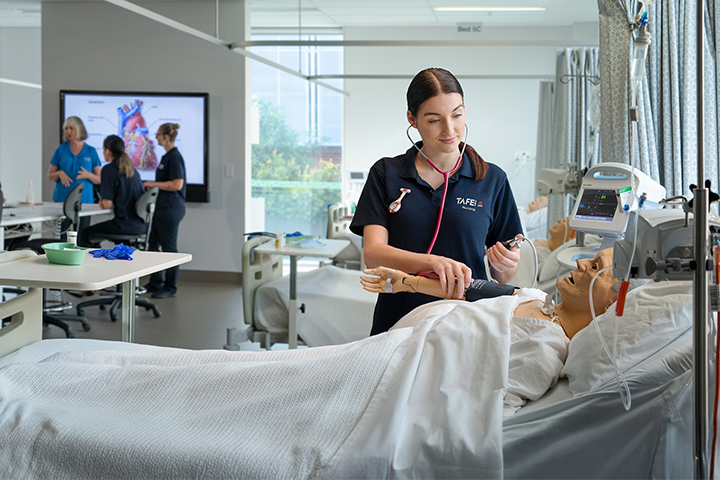
Exposure to industry-standard clinic rooms that reflect real healthcare settings.
Skills to manage your time, workload and patient care.
Confidence speaking with patients and collecting health information.
The ability to use the key steps of nursing care: assessment, planning, implementation and evaluation.
Suitability
Is this course right for you?
Entry requirements
This course requires evidence of previous experience or study before you can enrol.
Complete the eligibility check to find out if the Diploma of Nursing is suitable for you.
English language requirements
You must meet the Nursing and Midwifery Board of Australia’s English language standards. You’ll need to show a valid English Language Skills test result.
Or, you can declare that English is your primary language and that you have studied English for at least 6 years. This must include at least 2 years between years 7 and 12. You’ll need to provide school transcripts or a formal letter from your school as evidence.
Academic requirements
Successful completion of your Higher School Certificate (HSC) or year 12 equivalent.
Or, a certificate III qualification (or above).
You’ll need to show a copy of your transcript or certificate.
Language, Literacy and Numeracy (LLN)
Successful completion of an RU Ready / Basic and Key Skills Builder (BKSB) assessment. You’ll need to achieve Exit Level 3 or above in both English and maths.
Your TAFE NSW campus will arrange this assessment. We’ll let you know when and how to do this once you’ve applied.
Completion requirements
During your study you'll need to provide your teacher with the following evidence:
a Working with Children Check (WWCC)
Australian National Police Check (NPC)
vaccination and health screenings
anything else your work placement provider needs.
Entry recommendations
To be prepared for this course, we recommend that you have:
interpersonal skills
the ability to work rotating shifts in your career as a nurse
a reasonable level of fitness and flexibility to carry out manual lifting
the physical ability to perform 2 minutes of uninterrupted CPR on adult and infant manikins at floor level and respond to an emergency where there may be a risk to life.
We tailor our courses to meet local community needs, so some campuses may have extra entry requirements. Check your preferred location for details. Need help preparing? Contact us for support.
Find Your Fit
This simple tool guides you to a suitable course level based on your foundation skills and confidence.
Pathways
Future career and study options
Career pathways
Our graduates go onto roles like:
Enrolled Nurse
Enrolled Nurses provide nursing care to patients in a variety of health, aged care, welfare and community settings under the supervision of Registered Nurses.
Full-time share Full-time workers usually work 35 hours or more a week (in all their jobs combined).
57%
Employment size Employment size is the number of workers who do this as their main job.
6,900 workers
Average age This is the average age of all workers in this job.
45 years
Weekly pay Median earnings are shown for full-time, non-managerial employees paid at the adult rate, before tax or any amounts that are salary sacrificed. These figures are a guide to earnings only and should not be used to determine a wage rate.
$1,130
Average full-time The average full-time hours that people in this role work each week.
41 hours
Skill level rating Skill level ratings are based on the range and complexity of job roles. In general, the higher the skill level, the more formal education and training, previous experience or on-the-job training needed to be good at the job.
High
Gender share
88% female
Future growth The Department of Employment, Skills, Small and Family Business estimates the likely change in number of workers in this role, or industry, over the next 5 years. Future growth is the likely percentage change compared to all other job roles.
Strong Growth
Licensing
This course is accredited by the Australian Nursing and Midwifery Accreditation Council (ANMAC) and approved by the Nursing and Midwifery Board of Australia (NMBA).
To work as an enrolled nurse, you must be registered with the NMBA. Once you’ve completed this course, you’ll be eligible to apply for registration. You must meet the registration standards for enrolled nurses as outlined by the Australian Health Practitioner Regulation Agency (AHPRA).
Note 1: TAFE NSW will only grant credit for HLTENN units completed with a provider accredited by ANMAC and recognised by the NMBA. This complies with the Enrolled Nurse Accreditation Standards. Visit AHPRA to find out more.
Note 2: TAFE NSW registers all qualifying students with AHPRA. We must notify AHPRA if a student doing clinical training has an impairment that may place the public at risk of harm.
Study pathways
Take your study further with other courses offered at TAFE NSW:
Previous study2 Courses
Begin here to gain experience and confidence in this study area.
Further study0 Courses
Advance your skills to take your career to the next level
The Diploma of Nursing does not have any post-graduate courses.
Related study5 Courses
Learn core skills that prepare you for opportunities in your chosen field.
Your experience counts
At TAFE NSW, we recognise your previous study and work experience. You can apply for recognition of prior learning or a credit transfer with any of our courses. If you're successful you'll get your qualification faster.
Units
Units taught in this course
Courses are made up of a combination of both core and specialty units. In the Diploma of Nursing qualification, you’ll need to successfully complete 25 units of competency, including 20 core and 5 speciality units.
Please note, not all specialty units are offered at every TAFE NSW location. It is highly recommended that you check with your preferred campus for information about the specialty units offered at that location.
Core units - 20
Core units are central to the job outcomes of a particular industry or occupation. These are the units industry has agreed are essential to be capable and qualified at a particular study level.
Work with diverse peopleCHCDIV001
Promote Aboriginal and/or Torres Strait Islander cultural safetyCHCDIV002
Reflect on and improve own professional practiceCHCPRP003
Confirm physical health statusHLTAAP002
TAFE NSW services
Facilities and support
TAFE NSW provides support services across all campus locations and online. Whatever your needs or circumstances, we have the people, resources, counselling and facilities to support you in focusing on your studies.
TAFE NSW Disability Support Service
TAFE NSW Language, Literacy and Numeracy (LLN) support
TAFE NSW Aboriginal Support; Learner support (ABE)
TAFE NSW Careers, Counselling and Pathways Service
TAFE NSW Libraries
Scholarship programs - be supported as you explore your talents and fulfil your potential
Read&Write literacy and study support software is available free for all TAFE NSW students to use while studying on campus and at home
LinkedIn Learning - an online resource which offers innovative courses and tutorials to improve your personal and professional skills
Student associations - get social with our student community
Study options